
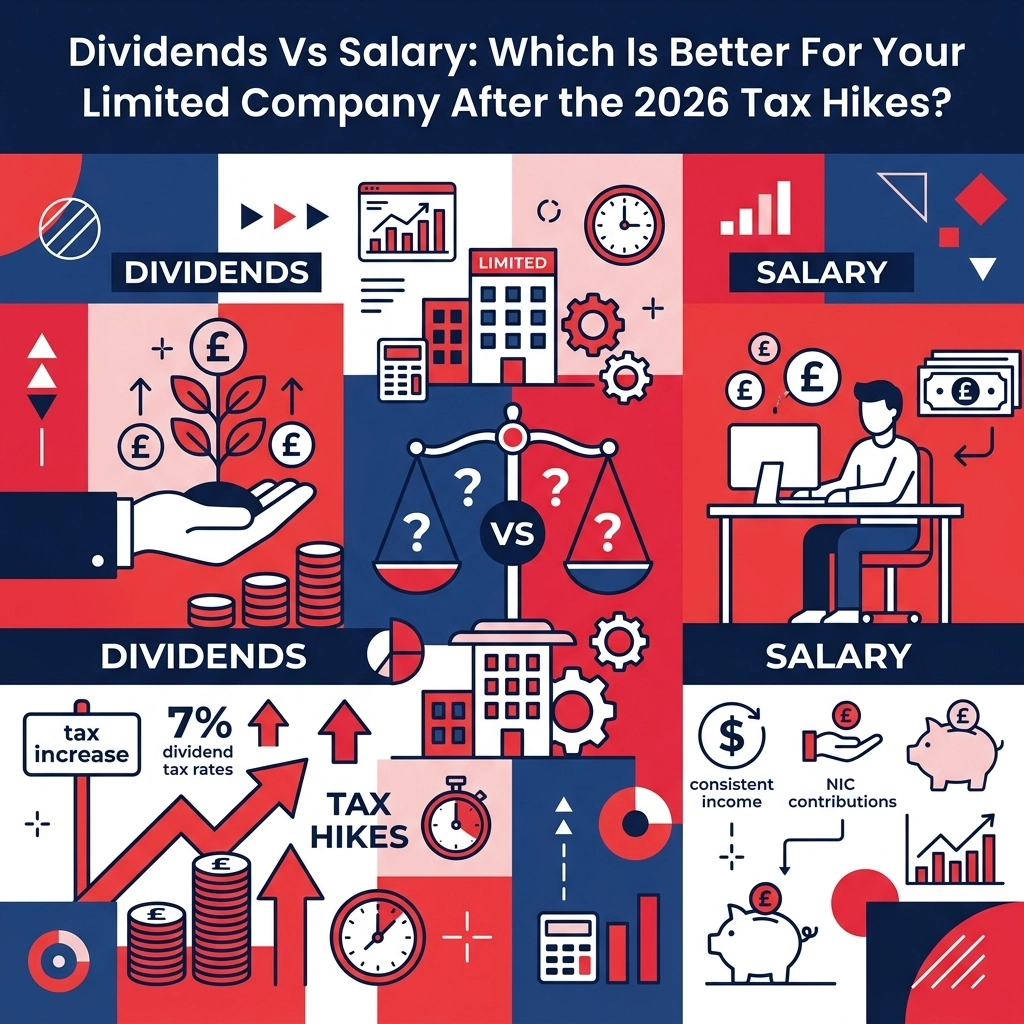
If you run a limited company, deciding whether to pay yourself through salary, dividends, or a mix of both has become a lot more important for 2026/27. With frozen tax thresholds, higher dividend tax rates, and corporation tax still sitting at 19% or 25% depending on your profit level, it is getting easier to pay more tax than you need to if your plan is not reviewed properly.
This is part of the "Double Whammy" many business owners are feeling right now. Costs are up, tax pressure is up, and the old rules of thumb do not always work anymore. We help business owners work through this in a practical way, so your pay strategy supports the business and still makes sense for you personally.
Information pertaining to tax year shifts…
Impact on corporate liquidity…
Regulatory compliance for directors…

The Personal Allowance for the 2026/27 tax year remains fixed at £12,570. This figure has been subject to a multi-year freeze, resulting in a phenomenon known as fiscal drag. As inflation impacts nominal earnings, a higher proportion of income is subject to taxation as individuals are pushed into higher tax brackets without a corresponding increase in the tax-free threshold.
| Category | Threshold Amount (2026/27) |
|---|---|
| Personal Allowance | £12,570 |
| Basic Rate Band | £12,571 to £50,270 |
| Higher Rate Band | £50,271 to £125,140 |
| Additional Rate Band | Over £125,140 |
The retention of these thresholds, when coupled with rising operational costs, is a major part of the "Double Whammy" affecting many UK businesses. It is exactly the kind of issue we help our clients navigate as part of their wider tax and profit planning.
Corporation Tax remains a primary consideration when determining the viability of salary versus dividend payments. Salary is classified as a tax-deductible expense for the company, thereby reducing the taxable profit. Dividends, conversely, are paid from post-tax profits.
The current Corporation Tax rates are applied as follows:
Planning around these rates matters. If your company falls into the marginal relief zone, the real tax cost behind dividend payments can be higher than many directors expect. That is why we look at the full picture with you, not just the headline rates.
The taxation of dividend income has undergone several upward revisions. For the 2026/27 period, the Dividend Allowance is maintained at the reduced level of £500. Any dividend income exceeding this amount is subject to the following rates:
These rates are higher than many business owners were used to in previous years. As a result, the tax advantage dividends once had over salary is now much narrower, which means a quick rule-of-thumb approach is less reliable than it used to be.
Taxation of investment income…
Shareholder distribution protocols…
Compliance with HMRC reporting…

Taking a salary requires the company to operate a Pay As You Earn (PAYE) scheme. While salary is subject to Income Tax and National Insurance Contributions, it provides specific benefits that dividends do not offer.
Many directors opt for a salary set at the Primary Threshold (£12,570) to use their Personal Allowance fully without triggering Employee or Employer NICs, depending on Employment Allowance eligibility. But the best answer is not always about chasing one tax saving in isolation. We usually look at payroll, corporation tax, dividends, and personal tax together so the setup works as part of your wider business plan.
The determination of the most tax-efficient extraction method is contingent upon the specific profit levels of the Limited Company.
At this level, the company is usually paying Corporation Tax at 19%. In many cases, dividends can still come out ahead because there is no National Insurance on them. Even with the 2026/27 basic rate dividend tax at 10.75%, the overall tax cost can still be lower than taking the same amount as salary.
Once profits move above £250,000, the company is generally paying Corporation Tax at 25%. At that point, the gap between salary and dividends gets smaller. Because salary reduces taxable profit, paying more salary can create a meaningful corporation tax saving for the company, which can sometimes balance out the extra personal tax and NICs.
Comparative data analysis…
Extraction optimization…
Profit-linked decision making…

The term "Double Whammy" is used to describe the dual impact of inflationary pressure on business costs and the stagnation of tax thresholds. While the cost of living and business operation has increased, the points at which individuals begin paying higher rates of tax have remained static.
This combination means business owners need a much closer look at how they pay themselves and how tax is building up across the year. We support clients with that ongoing view so they are not making decisions in the dark.
The choice between salary and dividends is further complicated by external regulatory triggers that are based on Total Taxable Income.
If a director or their partner receives Child Benefit and the director's "Adjusted Net Income" exceeds £50,000, a tax charge applies. This charge effectively claws back the Child Benefit. For those hovering around the £50,000 mark, the decision to take an additional dividend can trigger a significant tax liability that outweighs the value of the dividend itself.
Dividends are included in the calculation for student loan repayments. For directors with Plan 2 or Plan 4 loans, an additional 9% (or relevant percentage) of income above the threshold is deducted. This must be factored into the "net" value of any dividend distribution.

All profit extractions must adhere to the Companies Act 2006. Dividends can only be paid if the company has sufficient "distributable reserves." Paying a dividend in the absence of profit is considered ultra vires (beyond the powers) and can lead to the dividend being reclassified as a salary by HMRC, resulting in unforeseen tax and NIC liabilities.
Furthermore, accurate record-keeping is a statutory requirement. Minutes of board meetings must be recorded, and dividend vouchers must be issued to shareholders at the time of payment. Failure to comply with these administrative procedures can jeopardize the tax status of the distributions.
Compliance requirements for directors…
Documentation of board resolutions…
Statutory record retention…
The following table summarizes the primary tax rates relevant to Limited Company directors for the current period.
| Tax Type | Rate/Detail |
|---|---|
| Personal Allowance | £12,570 (Frozen) |
| Dividend Allowance | £500 |
| Basic Rate Dividend Tax | 10.75% |
| Higher Rate Dividend Tax | 35.75% |
| Additional Rate Dividend Tax | 39.35% |
| Corporation Tax (<£50k) | 19% |
| Corporation Tax (>£250k) | 25% |
| Effective Tapered Corp Tax | 26.5% |
For 2026/27, there is no single salary-versus-dividend answer that works for every director. The frozen £12,570 threshold, the reduced £500 dividend allowance, dividend tax rates of 10.75%, 35.75%, and 39.35%, and corporation tax at 19% or 25% all need to be looked at together.
The right approach depends on things like:
Talk to us at Titus Accounts
If the 2026 "Double Whammy" is making it harder to know the most tax-efficient way to pay yourself, we can help. We work as an extension of your team and look at the full picture, so you get advice that fits your business and your personal position.
If you would like a personalised tax efficiency review, talk to us at Titus Accounts and we will help you work out the most sensible next step.

Legal Disclaimer: This document is provided for informational purposes only and does not constitute formal tax or legal advice. Tax legislation is subject to change, and individual circumstances significantly affect the applicability of the information provided. Titus Accounts assumes no liability for actions taken based on this content without a formal engagement for professional services. Ensure compliance with all HMRC regulations and the Companies Act 2006 before authorizing distributions.
Talk to us at Titus Accounts for a personalised review.
Reviewing corporate tax structures…
Optimization of director remuneration…
Compliance with 2026/27 legislative standards…
Statutory Overview of the 2026/27 Tax Year...
The arrival of April is usually...

April 28, 2026