
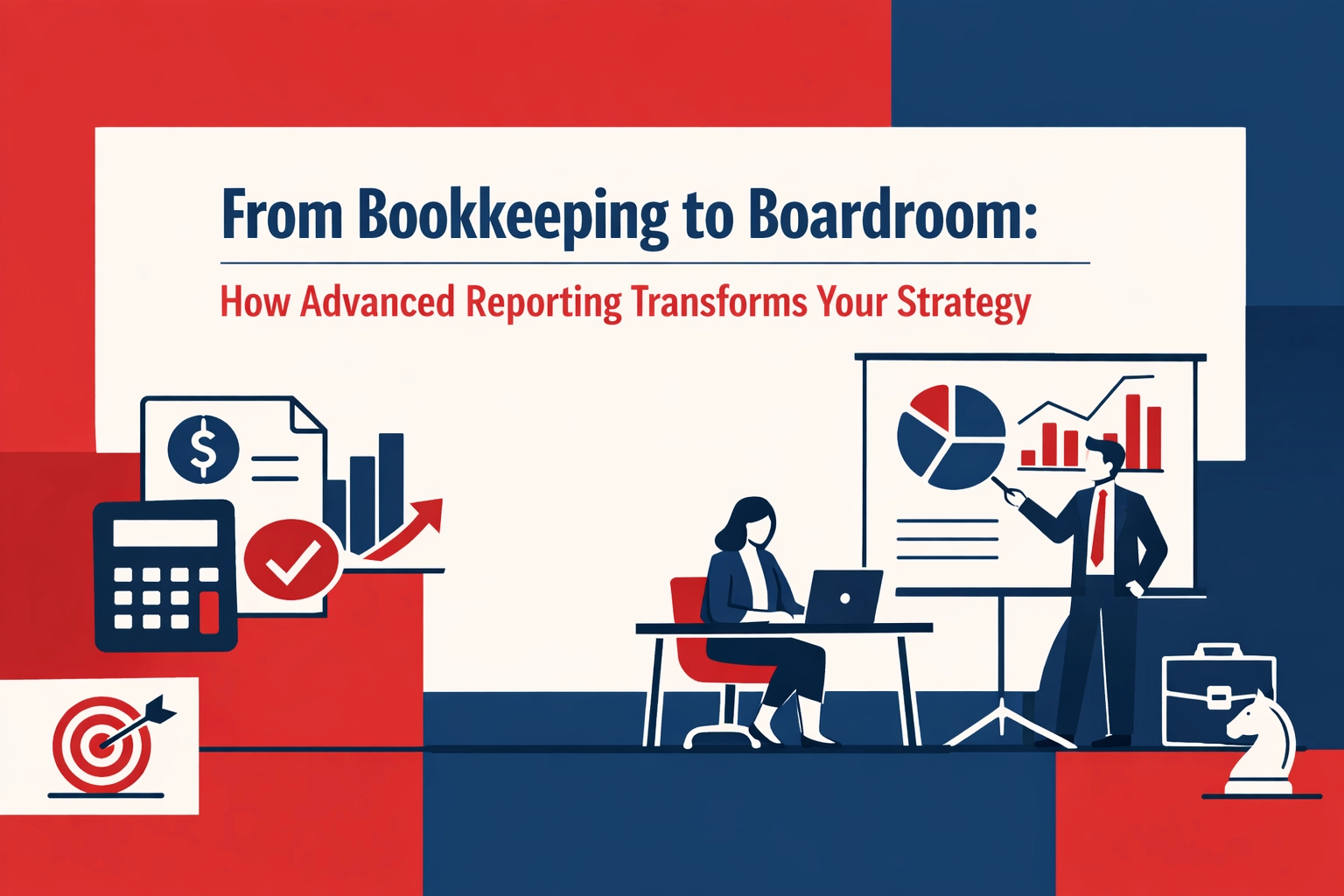
Most small businesses start with bookkeeping. Transactions are recorded. Receipts are filed. VAT returns are submitted on time. This approach maintains compliance and satisfies HMRC requirements.
However, compliance-focused bookkeeping does not generate strategic insight. The data exists within your accounting system, but it remains largely unused for decision-making purposes. This represents a significant missed opportunity for businesses seeking to scale or improve operational performance.
Advanced reporting transforms historical transaction data into actionable intelligence that informs boardroom decisions and drives competitive advantage.
Traditional bookkeeping serves a specific function. It records financial transactions in accordance with statutory requirements. The output consists of profit and loss statements, balance sheets, and tax computations.
These documents answer fundamental questions: What was our turnover last quarter? Did we make a profit? What tax liability has been incurred?
What basic bookkeeping does not provide is forward-looking analysis. It does not identify trends before they become problematic. It does not benchmark performance against industry standards. It does not model different scenarios to test strategic assumptions.
The result is that business owners operate with incomplete information. Decisions are made based on instinct or outdated data. Opportunities are missed. Risks materialise without warning.

Advanced reporting platforms extract data from your accounting system and transform it into visual, interactive dashboards that answer strategic questions.
Instead of reviewing static PDF reports, business owners access real-time data through customisable interfaces. Key performance indicators are tracked continuously. Trends are identified immediately. Anomalies trigger alerts.
The reporting architecture automates data transformation processes that would otherwise require manual intervention. Comprehensive analyses are generated in minutes rather than days. This acceleration enables responsive decision-making aligned with current market conditions.
Advanced reporting integrates financial data with operational metrics. Revenue can be analysed by customer segment, product line, sales channel, or geographical region. Costs are allocated accurately to specific activities or departments. Cash flow projections are updated automatically based on outstanding invoices and payment schedules.
This level of granularity reveals insights that remain hidden in traditional bookkeeping outputs.
Titus Accounts is a Fathom Certified Advisor. This certification confirms our expertise in implementing and utilising Fathom's analytical platform for client benefit.
Fathom connects to accounting platforms including Xero and QuickBooks to extract financial data automatically. The platform then generates management reports, financial forecasts, and board-ready presentations without manual data entry.
Key capabilities include:
Automated Management Reports: Monthly profit and loss statements, balance sheets, and cash flow statements are generated automatically. These reports can be customised to match specific business requirements or board preferences.
KPI Tracking: Business-specific metrics are monitored continuously. Targets are set within the platform. Performance against those targets is displayed visually through dashboards accessible on desktop or mobile devices.
Scenario Analysis: Financial models test different strategic assumptions. What happens if sales increase by 15%? How does a new hire impact cash flow over the next six months? These questions are answered through interactive modelling tools.

Multi-Entity Consolidation: Businesses operating through multiple legal entities benefit from consolidated reporting. Fathom aggregates data across entities to provide group-level financial visibility while maintaining individual entity analysis.
Industry Benchmarking: Performance is compared against industry averages. This benchmarking identifies areas where the business outperforms competitors and highlights opportunities for improvement.
Fathom transforms bookkeeping data into strategic intelligence that supports informed decision-making at all organisational levels.
Titus Accounts holds Syft Chartered Advisor status. This designation recognises our capability in deploying Syft's analytics platform to support client growth strategies.
Syft provides real-time financial reporting and analytics designed for businesses requiring immediate access to performance data. The platform emphasises visual data representation and collaborative reporting.
Core features include:
Live Dashboards: Financial metrics update in real-time as transactions are recorded in the underlying accounting system. Business owners access current performance data rather than waiting for month-end reports.
Custom Report Builder: Reports are created through an intuitive interface without requiring technical expertise. Data fields are selected, filters applied, and visualisations configured to match specific reporting requirements.
Collaborative Sharing: Reports and dashboards are shared with team members, board directors, or external advisors through secure links. Permissions control who can view or edit specific reports.
Cash Flow Forecasting: Future cash positions are projected based on historical patterns, current pipeline, and expected expenditure. This forecasting supports working capital management and financing decisions.
Client Portal: Accountants and clients access the same data simultaneously. This transparency facilitates more productive advisory conversations focused on strategy rather than data reconciliation.
Syft enables businesses to move beyond retrospective reporting towards proactive financial management based on current performance data.

Organisations implementing advanced reporting consistently report improved financial outcomes. Research indicates that businesses utilising strategic reporting platforms achieve a 20% increase in profitability through informed cost management and revenue optimisation decisions.
Enhanced Decision Quality: Executives navigate complexity with greater confidence when supported by comprehensive data analysis. Strategic actions are based on evidence rather than assumption.
Improved Cash Flow Management: Real-time visibility into cash positions prevents liquidity crises. Late payment patterns are identified before they impact operations. Investment decisions account for accurate cash flow projections.
Reduced Financial Risk: Automated reporting reduces manual errors inherent in spreadsheet-based processes. Data integrity improves. Compliance risk decreases.
Operational Efficiency: Management teams spend less time gathering data and more time analysing it. The reporting process accelerates. Decision-making cycles shorten.
Cross-Functional Alignment: Departments access consistent financial data. Strategy discussions are grounded in shared understanding of current performance and future projections.
Not every business requires boardroom-level reporting. Sole traders with straightforward revenue models may find basic bookkeeping sufficient for their needs.
Advanced reporting delivers maximum value for:
If strategic decisions are currently made without comprehensive financial analysis, or if month-end reporting arrives too late to influence operational decisions, advanced reporting platforms address these limitations.
Transitioning from basic bookkeeping to strategic reporting requires structured implementation. Data must be configured correctly. Users require training on platform functionality. Reporting frameworks must align with business objectives.
Titus Accounts manages this implementation process for clients. Our Fathom certification and Syft chartered advisor status confirm our technical capability. More importantly, our understanding of client business models ensures that reporting frameworks generate relevant insights rather than data for data's sake.
The implementation process typically involves:
The gap between bookkeeping and boardroom strategy narrows significantly when businesses implement advanced reporting platforms. Financial data transforms from compliance records into strategic assets.
For businesses seeking to scale, raise investment, or simply make better-informed decisions, advanced reporting represents a necessary evolution beyond traditional bookkeeping.
Titus Accounts provides strategic financial reporting services utilising Fathom and Syft platforms. Our certified and chartered advisor status ensures technical expertise. Our accounting background ensures that reporting frameworks serve business objectives rather than generating unnecessary complexity.
To discuss how advanced reporting could support your business strategy, speak to a professional accountant at Titus Accounts.
The arrival of April is usually associated with the tentative return of the sun and the beginning of a new financial year. However, for the UK...
1.0 Overview of Automatic Enrolment...

February 5, 2026